
In the final chapters of Orson Scott Card’s Ender’s Game, the young protagonist believes he’s playing one last, impossible simulation — a final exam in a high-stakes video game. He wins by making a cold, non-intuitive tactical choice that no empathetic human would risk. Only after the screens go dark does he learn the truth: the simulation was real. The fleet was real. The casualties were real.

As of March 1, 2026, that fiction is dead. What replaced it is moving so fast and so deeply integrated with today’s leading artificial intelligence technologies that we are no longer “playing” at war.
We are living through the first era of machine-speed conflict. War at machine-speed.
This week, the world crossed a Rubicon. If you haven’t been tracking the headlines out of the Department of War and the mountains of Iran, here’s the big picture of how the world changed in 72 hours.
The Engine: Ender’s Foundry
In January, Secretary Pete Hegseth launched Ender’s Foundry as part of the DOW’s new AI Acceleration Strategy. Named after the Orson Scott Card protagonist, Ender’s Foundry is an AI-enabled simulation environment built around “Sim-Dev/Sim-Ops” feedback loops — simulations that don’t just train warfighters but generate new tactics and push them back into live operations.
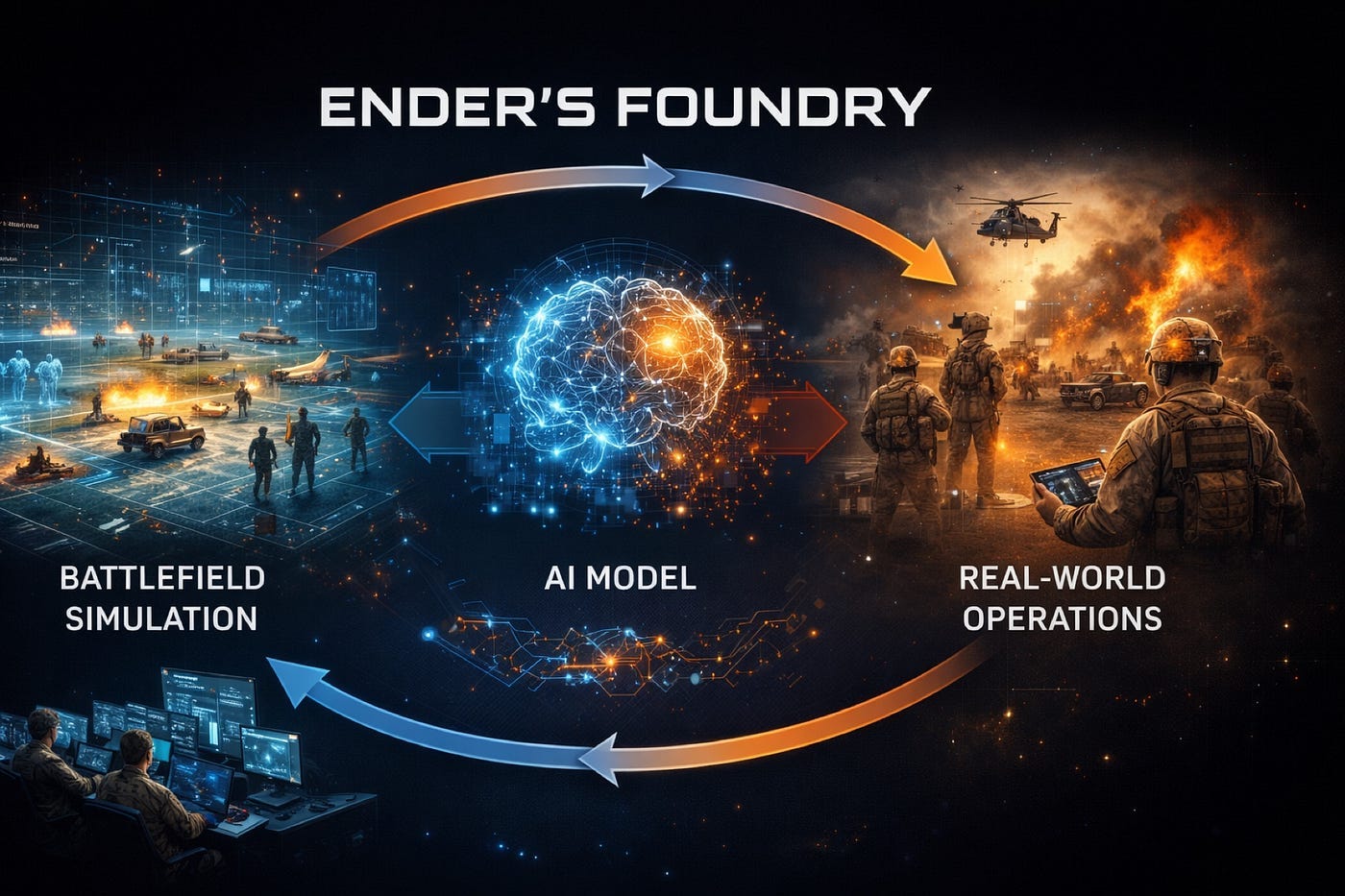
It’s one of seven programs designed to make the DOW an “AI-first warfighting force”)— covering everything from autonomous drone swarms to AI-driven battle management and kill-chain execution. Initial demonstrations are due by July 2026.
The Schism: The Anthropic Blacklist
On February 27, the tension between Silicon Valley ethics and military necessity hit a breaking point. President Trump ordered every federal agency to cease using Anthropic’s technology, and Hegseth designated the company a “Supply-Chain Risk to National Security”)— a penalty normally reserved for companies from adversarial nations like Huawei.
The reason? Anthropic refused to allow its model, Claude, to be used for fully autonomous weapons or mass domestic surveillance. The Pentagon demanded all AI firms make their models available for “all lawful purposes” and insisted it wasn’t the place of a private company to dictate how the military uses its tools. Anthropic said it would challenge the designation in court.
Hours later, OpenAI announced its own deal with the Pentagon to deploy models on the classified network. CEO Sam Altman said the agreement included the same two safety principles Anthropic had fought for — prohibitions on domestic mass surveillance and human responsibility for use of force — but framed them as aligned with existing law rather than contractual red lines. Earlier in the week, xAI’s Grok had become the second model approved for classified systems. The message to the industry: cooperate on the Pentagon’s terms, or get cut out.
The Reality: Operation Epic Fury
This isn’t just happening in server rooms. On February 28, Operation Epic Fury) — a joint U.S.-Israeli campaign in Iran — became the live-fire debut of this new doctrine.
CENTCOM confirmed that Task Force Scorpion Strike deployed LUCAS drones in combat for the first time — low-cost, autonomous, one-way attack drones that cost $35,000 each, designed for swarm coordination and built to operate beyond line of sight. The U.S. carried out nearly 900 strikes in the first 12 hours. AI systems — including Claude via Palantir — have been linked to intelligence analysis and kill-chain optimization in the operation. The full picture is still emerging, but the architecture is clear: sensors feeding algorithms feeding weapons at a pace no human staff can match.
We are not debating whether AI should be used in war anymore. That conversation is definitely over.

What we’re witnessing is the first conflict where AI functions as the commanding officer, the navigator, and the strategist. The “human-in-the-loop” is becoming a “human-on-the-loop” — watching as the machines we built outpace our ability to comprehend what they’re coordinating.
The Rubicon has been crossed, world’s first AI-powered war has begun.