
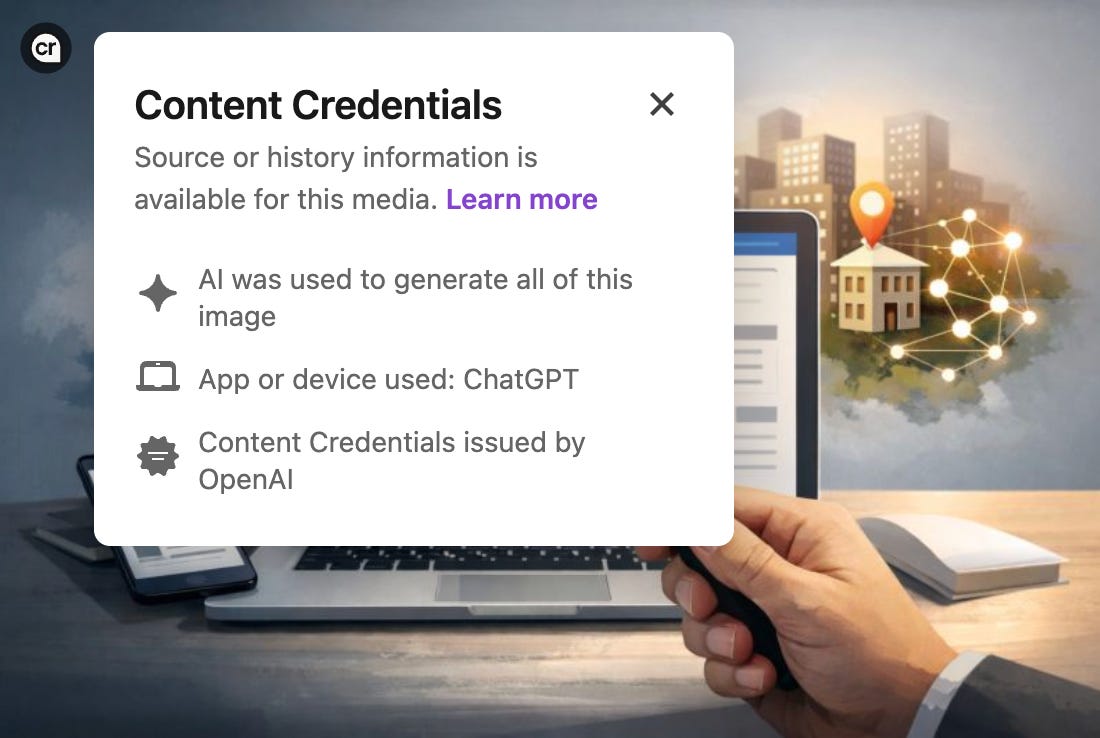
I was uploading a ChatGPT-generated image to LinkedIn — something to accompany a Substack post I’d written about trust signals, of all things — when I noticed a small symbol appear in the corner of the image. Clicked it. What came up was more detailed than I expected: a full breakdown of where the image originated, what tools were used, and exactly how much AI was involved.
The platform had flagged my AI-generated image. On a post about trust. You can’t script that.
That’s Content Credentials. And if you’re a founder, a CMO, or a brand builder, pay attention.
So What Actually Is This?
LinkedIn has adopted the C2PA standard — short for the Coalition for Content Provenance and Authenticity — an industry-wide framework that embeds verifiable metadata directly into image and video files. Think of it like a digital chain of custody: every significant edit or generation step recorded and attached to the file. Google, Meta, Amazon, OpenAI, Adobe, Microsoft, Sony, and Publicis Groupe are all on the steering committee — and Publicis is notable as the first major ad holding company to commit, which should tell you something about where this is heading.
When content carrying these credentials is posted to LinkedIn, a small C2PA icon appears. Anyone can click it and see who created the content, what tools were used, and exactly how much AI was involved.
The information is just sitting there, available to anyone curious enough to look.
The End of Quiet AI
Many teams are using AI to generate visuals while saying very little about it. That isn’t inherently wrong — but Content Credentials means the tools themselves are starting to do the disclosing for you.
Most marketing teams are treating this as a technical hurdle. The smarter move is to treat it as an ethical one.
Where Does Your Content Actually Fall?
To help teams think through this, we developed the Higgins-Berger Scale — a practical framework built around one core idea: AI involvement isn’t binary, it’s a spectrum, and what moves the needle ethically isn’t how much AI you used. It’s how much meaningful human judgment was in the loop.
Context and intent matter too. A fully AI-generated image accompanying a personal blog post hits very differently than a brand using the same workflow to sell a product while projecting authenticity. Same tool, same output, very different ethical weight.
A fully AI-generated image reviewed, curated, and refined by a skilled creative sits in a very different ethical position than a prompt-to-publish workflow where no human meaningfully touched the output. Content Credentials doesn’t know the difference yet — but your audience is starting to ask the question.
When someone clicks that C2PA icon on your post, they’re forming a judgment about where your brand falls on that spectrum. If your brand voice claims authentic human connection but your metadata tells a different story, no amount of clever copy closes that gap.
What Should You Actually Do?
Audit your stack. Find out which tools already sign content with C2PA credentials and what they’re telling the world about your process.
Know your ethical boundaries. You don’t need a formal written policy, but your creatives should know where the lines are before they start a project — not after. Adopting a framework like the Higgins-Berger Scale internally gives your team a shared language for those conversations, so ethical decisions happen by design rather than by accident.
Define your synthetic ceiling. Decide campaign by campaign where you play. A high-stakes brand campaign might demand human-led work throughout. High-volume social might make a more AI-driven workflow the right call. The point is to choose intentionally, not by default.
The Bigger Picture
Audiences are actively learning to distrust what they see. Deepfakes and AI-generated disinformation have made people genuinely skeptical of polished content in a way they weren’t two years ago.
Content Credentials give people a tool to evaluate the what. The Higgins-Berger Scale gives your organization the why. Together, they represent a shift toward a creative economy where provenance actually means something.
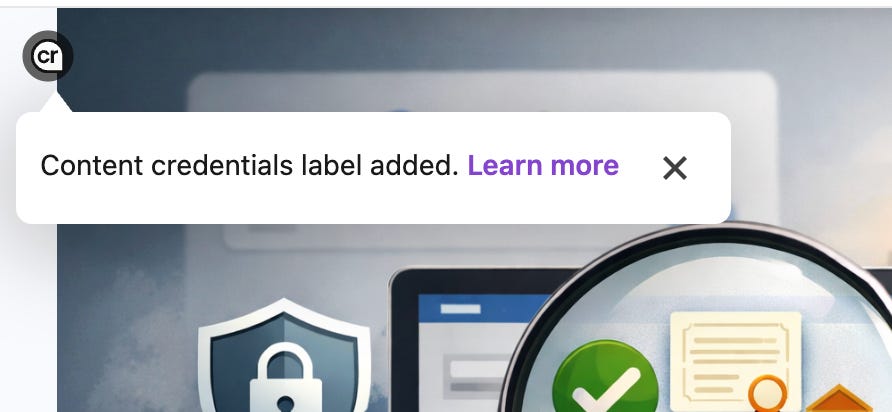
That icon is already in the corner of your LinkedIn feed. The question is whether your brand will be ready when someone clicks it.