
When I was a kid, my family spent summers down the Jersey Shore, and my parents often took us to the Atlantic City Boardwalk. There were arcades, saltwater taffy, diving horses, and a sideshow called Gorilla Girl. My parents never let us inside, but watching people come screaming out of the exit was entertaining enough.
Across from Steel Pier, a costumed Mr. Peanut greeted customers outside the Planters store. He scared me. Even in the 1970s, an enormous peanut dressed like a Victorian aristocrat seemed like a creepy relic from another century.
Mr. Peanut dates back to 1916, when Planters gave an ordinary snack a recognizable personality. Tony the Tiger and the Pillsbury Doughboy followed much the same formula.

None of these characters made their products any better; they made the brands feel more familiar.
In 1997, Microsoft took the idea further with Clippy, an animated paperclip whose offers of assistance were considerably more enthusiastic than useful. The corporate character had become part of the product itself.
Today, AI companies are taking that idea considerably further. Meta has Jolly, a cuddly character associated with its Muse AI agent. OpenAI has Dots, customizable agents represented by colorful characters, and Microsoft has experimented with Mico, an expressive animated companion for Copilot.
Unlike their predecessors, these characters represent systems that can remember personal information, access applications, and increasingly take actions on our behalf.
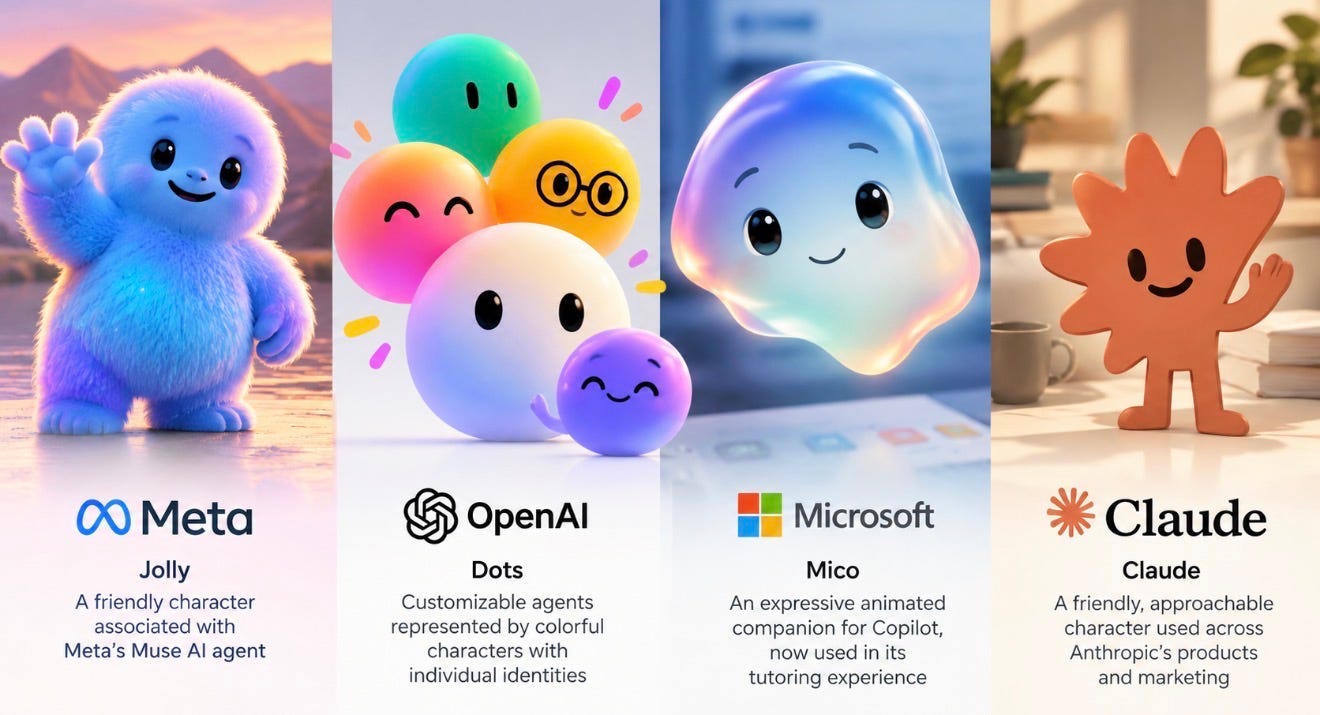
Psychologists call our tendency to assign human characteristics to nonhuman things anthropomorphism. Advertisers have exploited it for generations, and there’s research demonstrating how it influences trust. A 2026 University of Toronto study found that people trusted chatbots more and disclosed more personal information when the systems communicated in more humanlike ways.
Researchers also found that people who tended to assign greater responsibility to AI systems tended to assign less to the companies behind them. Although making the AI more humanlike didn’t directly reduce corporate blame in the experiment, it did increase the responsibility assigned to the AI itself.
The study examined conversational behavior rather than cartoon mascots, but the commercial incentives are familiar. Companies want us to engage with their products, share information, and become comfortable relying on them. An approachable personality can help accomplish that without necessarily making the underlying technology any more reliable.
I use AI every day for work and personal projects, and I’m genuinely enthusiastic about its potential. I also appreciate good branding, clever character design, and technology that doesn’t require an engineering degree to operate.
There’s nothing inherently wrong with making AI approachable.
But a friendly interface can make a system feel more trustworthy than it has earned the right to be, and a charming mascot can obscure the company’s responsibility for what that system does.
Mr. Peanut spent more than a century trying to convince us that Planters was a brand we could trust. His new digital counterparts are asking us to trust them with considerably more than our choice of peanuts.